
SUMMARY OF THE ARTICLE
- A turmoil induced by new technologies
- Digital transformation is not a new concept as it has existed since the rise of the Internet.
- Digital transformation: a human and common vision at the center
- Digital transformation: a deep hierarchical restructuring
- Digital transformation
- 75% of the global population now has a mobile phone. A major axis in the digital transformation of businesses.
- Working differently through digital transformation
- At the center, we can implement a set of collaborative tools aimed at bringing people closer together and integrating them into a co-creative and productive approach.
- of silos also tend to disappear in favor of cross-management, less dependent on hierarchical weight.
Hierarchies
- Big Data, a valuable source of data in digital transformation
- Digital marketing, a pillar of digital transformation
- The human being at the heart of transformation
- Digital transformation cannot be achieved without a profound evolution in our way of thinking.
- A new way of viewing digital transformation
- Digital transformation, a current and future challenge
- Training to address digital in business
- Infographic: 7 steps to start digital transformation
Like the industrial revolution that profoundly changed 19th-century society, the digital transformation of businesses is changing our society today.
It is now an integral part of our daily lives and, above all, it must develop and intensify in the coming years. Businesses, employees, or customers, no one can escape it.
But what is digital transformation?
A disruption caused by new technologies
Digital transformation, sometimes referred to as digital transformation, is theprocess that allows businesses to integrate all available digital technologies into their operations.
These technologies aim to improve many aspects within companies and, together, enable them to continue their growth. We are always looking to sell better, respond better to customer needs, and above all, provide the right information at the right time.
To achieve this, it is necessary to know your customers and future customers perfectly and to be visionary in a rapidly changing world. Knowing what will work tomorrow is within our reach by understanding new consumption patterns, and it is through our actions and the information we abandon day after day that this becomes possible.
The digital transformation of businesses is therefore a profound change that meets future needs. One of the major issues is the ability to talk about the data that companies have accumulated over many years. How to interpret this data?
Digital transformation is not a new concept as it has existed since the rise of the Internet.
One of the most obvious examples of this technological revolution in the business world is the normalization of email in the daily lives of employees. Communication modes are evolving, and we must adapt quickly and sometimes relearn the fundamentals.
When we talk about generations X, Y, and Z and their ability to adapt to new technologies and tools, it is sometimes necessary to have been educated through them. Learning to use these technologies can be a barrier for many employees in businesses, or worse, they may be resistant to them.
However, new generations, especially Generation Y, were born with these new technologies; smartphones, tablets, and numerous applications including social networks have become their daily life. This leads us to understand new forms of communication and consumption in an ecosystem where time has a significant hold on people. You always have to go faster!

While digital appeared first (the digitization of documents constituting the first digital heritage of humanity), digital has facilitated the use of various technological tools.
Digital transformation: the human and common vision at the center
Transformation is a human issue and without them, there can be no major progress in the digital transition of the company. The first thing to have in companies that are digitizing is a common vision on the subject of digital transformation.
You must be able to educate and evangelize on the subject before training your teams on the main axes of the company’s digital transformation. Human relationships play a predominant role in this transition, and it is their responsibility to support staff and respond to their needs and questions.
This is not a minor issue, but rapid and effective transformation must focus on human beings and a shared vision internally.
Training will then follow to allow everyone to take their place and position within the company.
Digital transformation: a deep hierarchical restructuring
Digital transformation is always accompanied by a multitude of projects to be implemented internally. The hierarchy is often one of the first targeted projects, but also the most complex to rework from a human perspective.
It is always difficult to touch on gains and then reshape the responsibilities and latitude of employees. The principle of redesign aims to break down silos and distribute skills often emphasizing collaborative work.
It is essential to highlight ideas, skills… and to focus on the human being in the context of a digital transformation.
Digital transformation at the time of mobile
75% of the global population today uses a mobile phone. A major focus on the digital transformation of businesses.
And for several years, smartphones, these smart phones, have generated real enthusiasm because they give their users control over technology while offering them freedom of movement.

It is therefore impossible for businesses to ignore this reality; on the contrary, many companies like Uber have built their business model on mobile phones , focusing on some of its strengths such as geolocation and real-time capabilities.
The smartphone has become one of the main drivers of digital transformation. It is no surprise in a world where Internet consumption is increasingly evolving thanks to these new portable computers. If we had initially stayed with a simple phone, it is now a question of a tool representing the future of computing. This tool, which can easily be slipped into a pocket, sometimes contains the entire life of its user between emails, photos, and the numerous applications they use.
It can be said that it not only eliminates distances between people, because it abolishes temporal barriers thanks to real-time communication, but also because it allows everyone to connect anywhere in the world.
Working differently thanks to
Mobility is today one of the strong symbols of digital transformation; it is valuable in our daily lives but also in our professional lives.
At the center, we can implement a set of collaborative tools aimed at bringing people closer together and integrating them into a co-creative and productive approach.
It foreshadows the disappearance in the short or medium term of the physical limits of the company, or at least of companies subject to the global digitization of their activities and services.
Isn’t this already the case with telecommuting, which is becoming widespread during the digital transformation? Other forms of work such as nomadism and freelancing are emerging in turn, replacing the traditional business operating mode.
Silo hierarchies also tend to disappear in favor of cross-management, less dependent on hierarchical weight.
Digital transformation therefore includes the ability to work differently and from anywhere in the world. Being efficient and productive no longer means setting limits by confining them to a professional space, but rather the ability to evolve from anywhere and collaboratively.
Big Data, a valuable source of data in digital transformation
Digital transformation allows companies to access an infinite amount of data about their customers , through the information we provide on the web: written messages, published videos, social networks, websites visited, forms filled out…
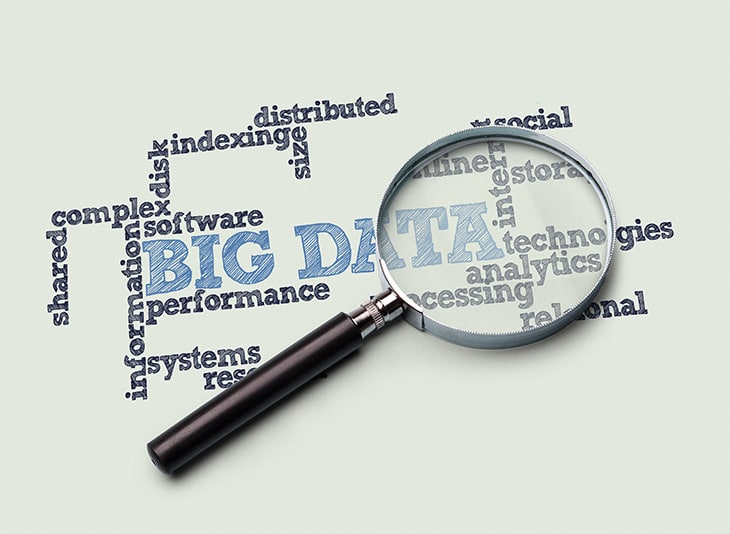
This data can be retrieved internally or purchased from data specialists. Many companies are interested in this information because big data is, in their opinion, a real gold mine for optimizing their business model.
They try to make this data speak to improve their profits, but this is not yet a guaranteed and won axis for everyone. The main difficulty encountered with Big Data is precisely the ability to make the data speak and, above all, to interpret it well… what to make it say and for what purpose?
If Big Data will not define the business model of tomorrow, you will need to have a vision and thus anticipate models, new axes, etc… It is therefore important to be visionary and to get closer to the consumer representing this new digital era!
Digital marketing, a pillar of digital transformation
Digital marketing or online marketing is one of the main pillars of digital transformation. To improve relationships with customers, companies rely on digital channels to promote or sell their products.
When we talk about selling through digital channels, we immediately think of social networks and social selling. A new term, in my opinion, designating the ability to adapt to new tools to sell better and more. Old methods have more or less disappeared, and if the digital consumer is a profile born with a smartphone in their hands, they must know how to speak to them and sell to them on their turf.
Of course, we can mention websites, mobile sites, social networks, or applications for tablets and smartphones.
But they also use digital tools such as email, SEO, paid keyword acquisition (SEM), or SMS Pro.
The set of actions and tools that make up digital marketing is a priority in digital transformation , as it allows for the expansion and measurement of its actions. Note the importance of training your teams in advance if necessary.
Some organizations go through the redesign of their website to meet new standards and facilitate user experience. This usually requires a check and assessment of priority needs. The digital footprint of the company is evaluated on the other side.
The human being at the heart of digital transformation
Digital transformation cannot be reduced solely to the technological revolution of the web and its tools. It also traverses a human story, with our way of thinking that must evolve simultaneously.

Companies must take into account the new reality of digital transformation: it is by bringing digital culture to life, giving it a human framework that they will stimulate innovation and truly increase their activities.
Digital transformation cannot be achieved without a profound evolution in our way of thinking.
A new way of seeing digital transformation
Putting people at the center of digital transformation is only possible if the company agrees to do so. In particular, the role of HR is to encourage their staff to undergo training adapted to the evolution of technologies.

But will they do it knowing that 47% of French companies consider digital technology a passing phenomenon?
Digital transformation, a current but also future challenge
Only 31% of business leaders in France consider digital transformation a real opportunity.
However, it is necessary to understand the mechanisms and challenges of digital transformation for all companies wishing to develop their business.
Because digital transformation is in perpetual motion; it does not seem to want to stop, neither today nor tomorrow.
Development of cloud computing, the Internet of Things, smart data, connected health, 3D printing, virtual reality, or collaborative robotics, all these technological concepts are shaping our future life. The technologies of the future are already here and they are very present!
It is up to humans to adapt to new technologies and not the other way around. Grounded in the world of new technologies, future generations should not feel the digital transformation; at least not as much as today’s employees.
Each of us must be ready to take the plunge if we do not want to miss the train that is passing, that of digital transformation…
Training to address digital in business
Training is one of the main areas to rely on to improve all employees, including those at the forefront of the company’s digital transformation. However, training is very numerous and there are also many centers offering digital programs.
This is therefore an in-depth job that HR must carry out internally to guide staff in response to essential needs. The use of digital tools, big data, project management, innovation management, and digital transformation itself are topics to discuss regarding internal changes. We can elevate emlyon with business management and digital transformation as a long course, but undoubtedly more will happen in the months and years to come.
It can be considered that all training courses related to digital in the broad sense can be useful to any employee of a company depending on their progress in terms of transformation.
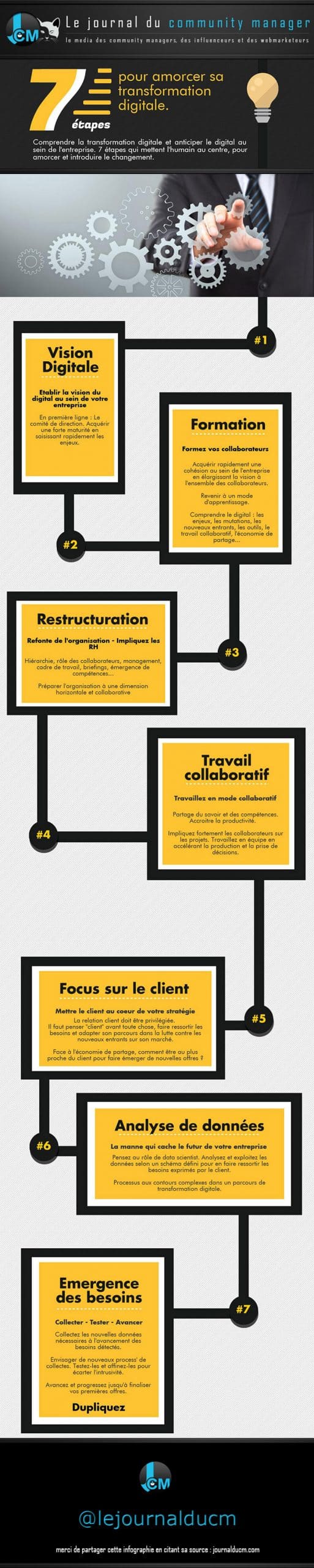
Infographic: 7 steps to start digital transformation
Here is an infographic that outlines the 7 classic steps to begin your digital transformation.
Tag: digital transformation