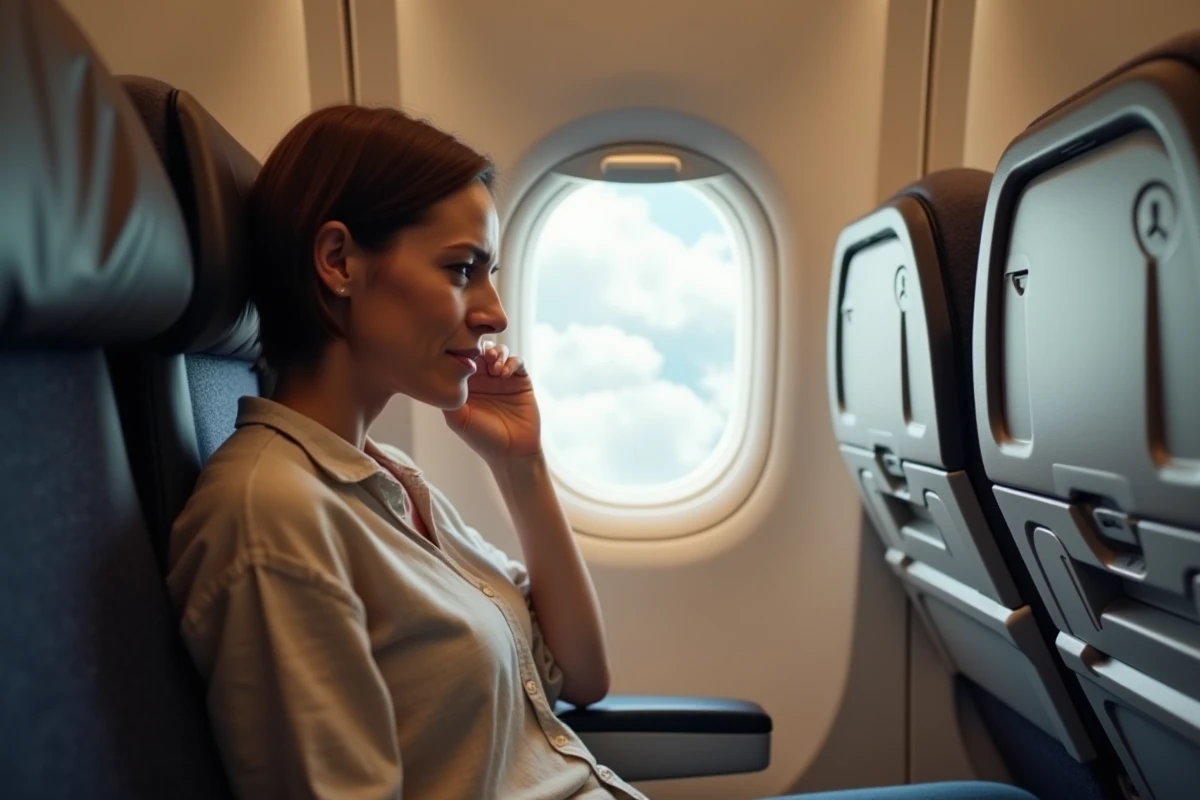
A passenger prone to dizziness or recurrent ear infections does not choose their seat at random. The seat influences auditory comfort throughout the flight, not just because of legroom. Pressure variations, cabin humidity, proximity to the engines: one can limit the damage even before boarding, provided they know what to look for in terms of the fuselage.
Wing area and ear pressure: the game-changing placement
Most travel guides mention the area over the wings to reduce turbulence. What is less known is that this area, close to the aircraft’s center of gravity, is also where the pressure variations felt are the most gradual for the inner ear. For passengers prone to migraines triggered by pressure changes or dizziness, this is the primary selection criterion.
People suffering from Meniere’s disease and ear pain on a plane should aim for the middle rows. Sitting at the back of the aircraft, where movements are amplified, exposes the inner ear more and can trigger a dizziness attack in sensitive individuals.
In practice, one can identify the rows located between the two emergency exits on the cabin plans available during booking. On a single-aisle aircraft like the A320, this generally corresponds to the rows near the wing. On a long-haul flight, the useful area is broader, but the principle remains the same: aim for the geometric center of the plane.
Cabin humidity and Eustachian tube: an underestimated link
It is often thought that ear pain on a plane comes solely from the pressure differential during takeoff and landing. However, the cabin air plays a direct role. The relative humidity in the cabin often drops below 20%, a level that dries out the nasal mucous membranes within a few hours of flight.
Dry mucous membranes mean a Eustachian tube that does not function as well. This small canal connects the middle ear to the back of the throat and normally opens when swallowing or yawning. When the surrounding tissues are dehydrated, the opening does not occur properly, and pressure remains trapped behind the eardrum.
What can be done before and during the flight
- Use a saline nasal spray (physiological serum) about an hour before boarding, then every two hours during the flight, to maintain mucous membrane hydration
- Drink still water regularly during the flight, in small sips, rather than a large glass with meals
- Avoid alcohol and coffee in the cabin, which accelerate tissue dehydration and worsen nasal dryness
These actions are not spectacular, but they directly affect the ability of the Eustachian tube to equalize pressure. On a flight longer than four hours, the difference is noticeable.
Landing and barotrauma: why descent poses more problems
The critical phase is not takeoff. It is landing. During ascent, air naturally exits the middle ear to the outside. During descent, it must enter, and the Eustachian tube resists more in this direction. If it is inflamed or congested, external pressure pushes the eardrum inward, causing sometimes severe pain.
This is when the risk of middle ear barotrauma is highest. Travelers with colds or sinusitis are the first affected. Nasal congestion mechanically blocks the Eustachian tube, preventing any pressure regulation.
Actions to take as soon as descent begins
The Valsalva maneuver remains the most well-known technique: pinch your nose, keep your mouth closed, and gently blow to force the opening of the tube. It works well for adults, but it should be repeated several times during descent, not waiting for the pain to set in.
Chewing gum or sucking on a candy activates swallowing, which reflexively opens the Eustachian tube. Start chewing ten minutes before the announced landing, not when the ears start to plug.
For young children, giving a bottle or pacifier during descent encourages regular swallowing. Babies cannot perform the Valsalva maneuver, and their Eustachian tubes, which are shorter and more horizontal, can become blocked more easily.
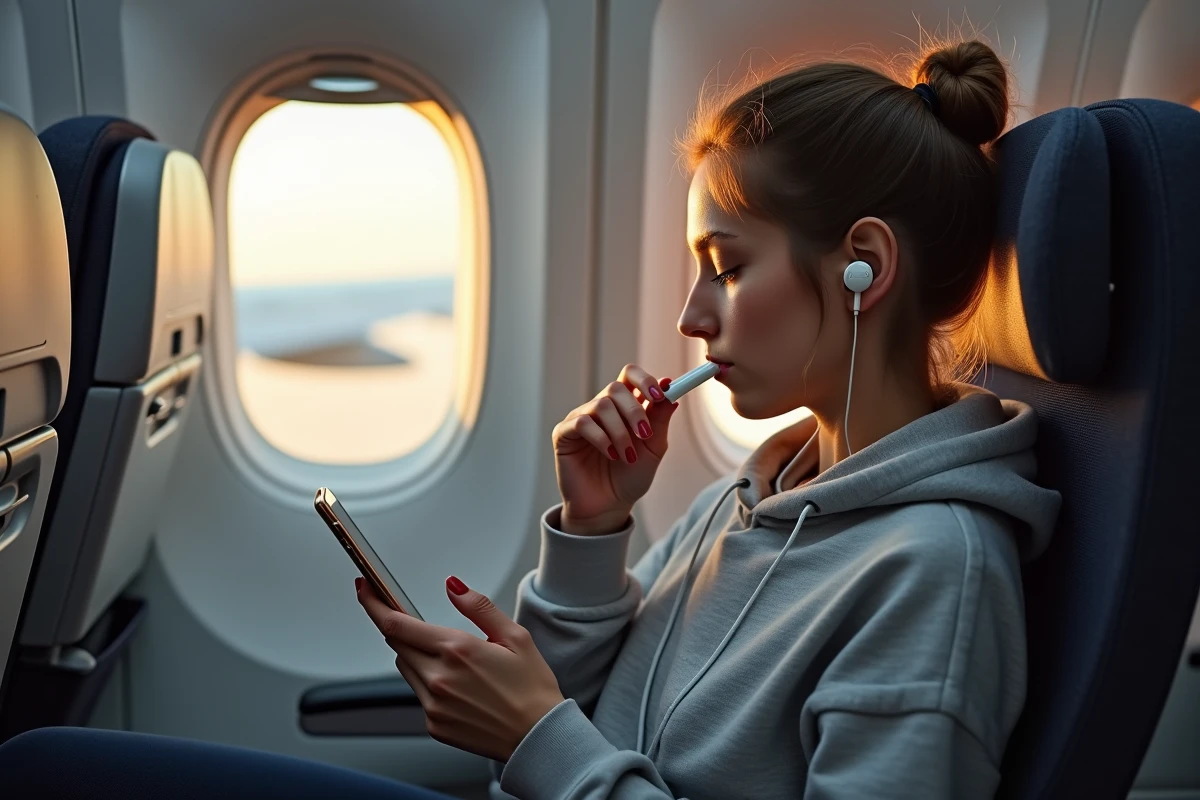
Occasional travelers after the pandemic: a profile at increased risk
Since the resumption of air traffic post-Covid, hospital ENT specialists have noted a rise in consultations for barotrauma among occasional travelers. After several years without flying, the ear loses a form of habituation to rapid pressure changes.
Additionally, flights are often fuller, making it nearly impossible to change seats in case of discomfort. When one has not flown for a long time, the choice of seat at the time of booking becomes even more important.
Filtered earplugs or classic earplugs
Ceramic or valve-filtered earplugs (like “airplane plugs”) slow down the speed at which pressure reaches the eardrum. They do not eliminate the differential but spread it over time, allowing the Eustachian tube time to compensate. Feedback on this point varies according to the shape of the ear canal, but they remain a simple option to test.
Classic foam earplugs, on the other hand, reduce noise but have no effect on pressure regulation. Do not confuse sound insulation with protection against barotrauma.
- Filtered earplugs (like EarPlanes or Alpine FlyFit): designed to regulate pressure, to be inserted before takeoff and removed after landing
- Foam earplugs: useful for sound comfort and sleep, with no effect on ear pressure
- Candle plugs: good sealing for rest, but the same limitation as foam regarding pressure variations
Choosing a seat over the wings, keeping mucous membranes hydrated, and anticipating descent with the right actions cover the main aspects of the issue. The rest depends on each individual’s medical profile: in case of ongoing ear infections or chronic ENT conditions, seeking medical advice before flying remains the most reliable precaution.