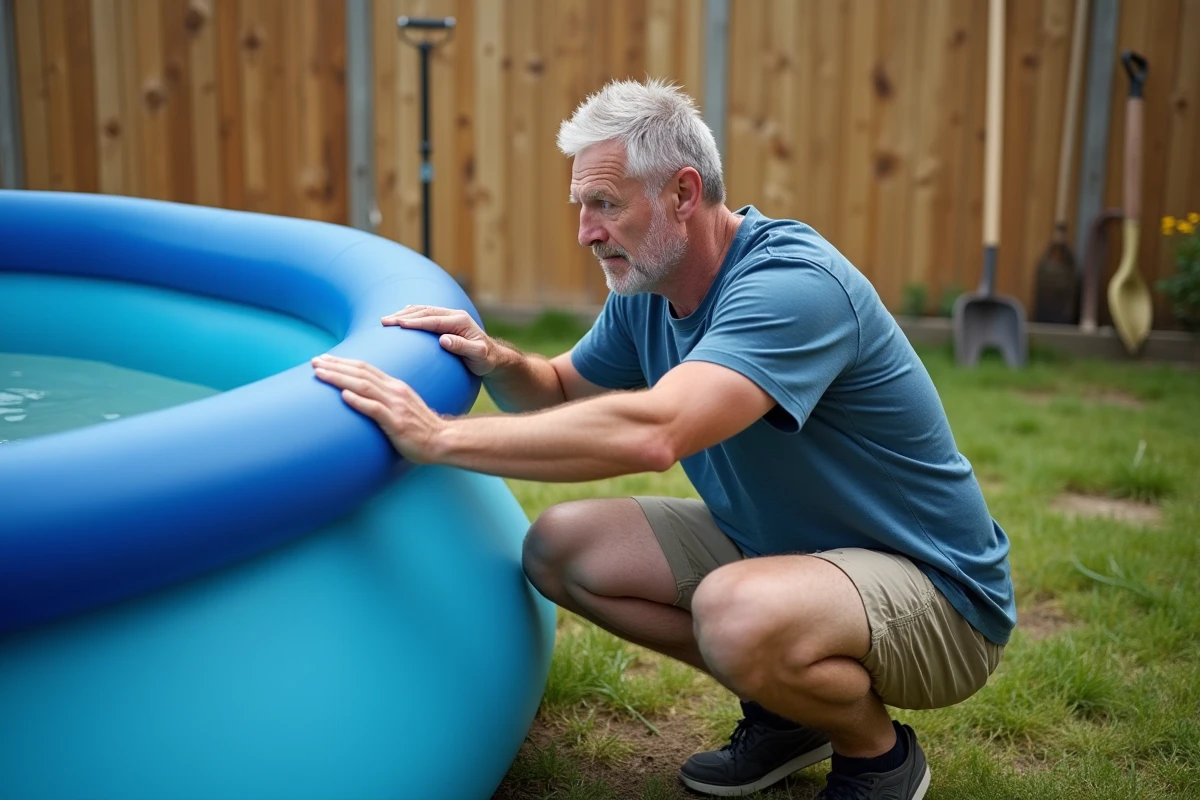
An above-ground pool that tilts by a few centimeters exerts asymmetric pressure on the inflatable ring and the liner. This localized overload accelerates the fatigue of the PVC, deforms the structure, and in the most pronounced cases, causes a sudden tipping with partial drainage. Correcting the tilt is not just a matter of visual comfort; it is a question of the mechanical stability of the pool.
Tolerance threshold and constraints on the liner of an above-ground pool
The liner of an above-ground pool works under uniform radial tension when the ground is level. As soon as one side is lower, the water column on that side increases, and the hydrostatic pressure on that portion of the liner grows proportionally. The PVC deforms, the upper ring sags on one side, and the weld between the liner and the ring undergoes a shear force for which it is not designed.
Beyond a 3 to 4 cm difference in level, Intex and Bestway customer service frequently refuse to cover liner tears. Their manuals require a “perfectly level” ground, and any visible tilt in the photos of the damage is enough to invoke the exclusion clause. We observe that many users discover this reality only after a tear, not before.
There is a comprehensive guide for straightening a tilting above-ground pool that details the steps for diagnosing and correcting the ground. The key point to remember: even a tilt considered minor to the naked eye can exceed the critical threshold if the pool has several meters in diameter.
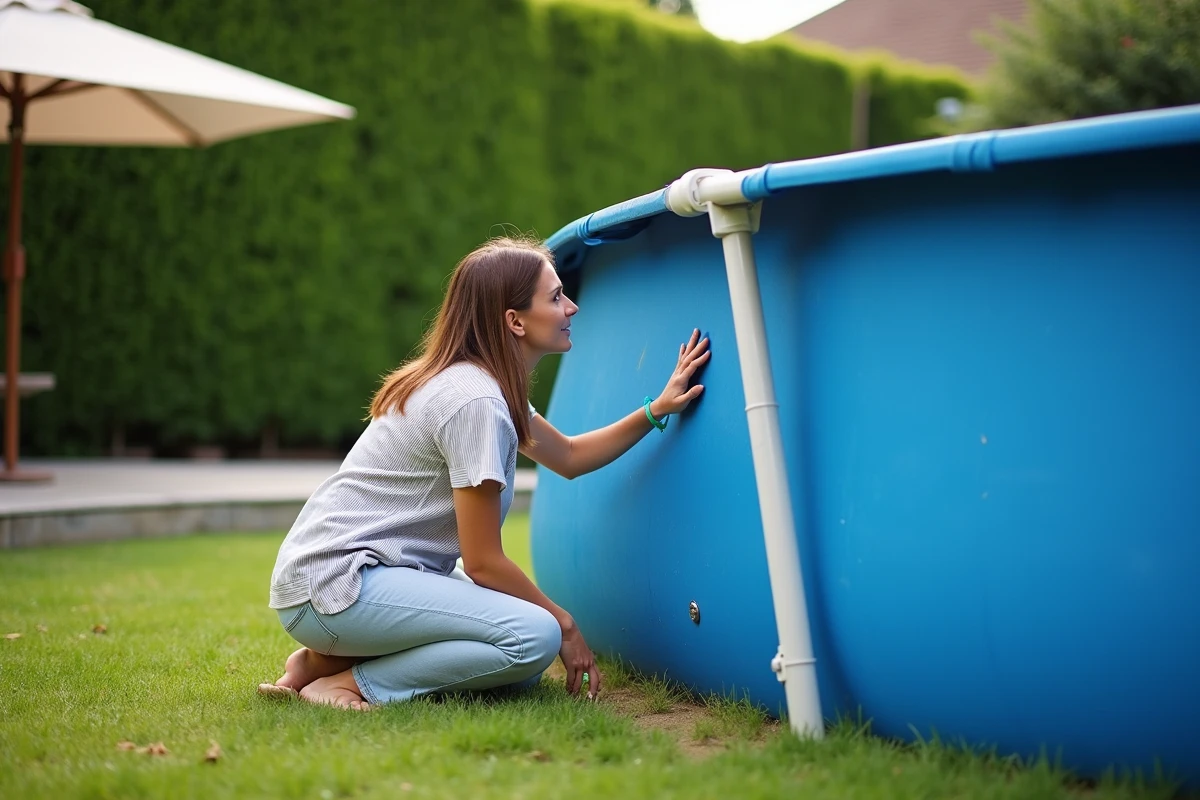
Ground diagnosis before draining: laser level and stake method
Before emptying the pool, we recommend measuring the gap precisely. A spirit level placed on the ring gives a rough indication. A rotary laser level placed at the center of the area provides a reliable reading across the entire seating surface, with millimeter-level precision.
The stake method remains accessible without expensive equipment:
- Drive stakes every 50 cm along the two perpendicular axes of the intended diameter, extending them to the same height
- Tighten a string line between the opposite stakes and measure the gap between the string line and the ground at each intermediate stake
- Transfer the values to a sketch to identify the high and low areas, which guides the earthworks
This survey allows for distinguishing two very different situations: a generally sloped terrain (regular slope) or a bumpy terrain (localized dips and bumps). The correction is not the same in both cases.
Ground correction: excavation, compacted sand, and mistakes to avoid
The most reliable solution is to excavate the high area rather than backfill the low area. Uncompacted backfill settles under the weight of the water in a few days, and the tilt reappears. In recent years, we have noticed a clear trend to hire an earthmover to correct the ground, rather than improvising with wedges or pallets.
Steps for preparing the ground
Once the pool is emptied and moved, excavate the topsoil in the identified area. Remove stones, roots, and debris. Apply a layer of sand (masonry sand type, not beach sand) to a sufficient thickness to absorb the residual irregularities.
Compacting the sand is the step that most DIYers underestimate. A pass with a vibrating plate or a weighted lawn roller is necessary. Tamping by hand or foot is not enough: uncompacted sand will sink under the weight of the water within the first hours of filling, recreating low points.
Check the final level with a laser level or string line before reinstalling the pool. The goal is a gap of less than 1 cm across the entire diameter.
Recurring mistakes
- Placing polystyrene sheets or patio slabs without correcting the ground underneath: they mask the tilt without eliminating it and fracture under pressure
- Shimming one side of the pool with boards or cinder blocks: the point load punctures the liner and creates an unstable support
- Partially filling and then attempting to move the pool: even a half-full pool weighs several hundred kilos, the liner deforms, and the ring tears
Home insurance and above-ground pool: the installation defect trap
Damage caused to a house or property by the rupture or tipping of a poorly installed above-ground pool can be excluded from home insurance coverage on the grounds of installation defect. Several French insurers apply this clause as soon as the ground is visibly unstable or not prepared according to the manufacturer’s specifications.
We recommend documenting the ground preparation: photos of the excavated ground, compaction, and laser level checks. If an earthmover is involved, keep the invoice. These elements constitute proof of proper installation in case of a claim.
Without this documentation, a simple subsidence of the ground after a rainy episode can turn a covered water damage into a denied claim. The cost of proper ground preparation remains marginal compared to the amount of a denial of coverage.
The stability of an above-ground pool is determined before filling, not after. A precise level survey, excavation rather than backfill, mechanical compaction of the sand, and a few dated photos are enough to ensure the pool’s stability and protect the insurance coverage. Straightening a pool already in place without complete drainage is a false economy: the only reliable method involves reworking the bare ground.