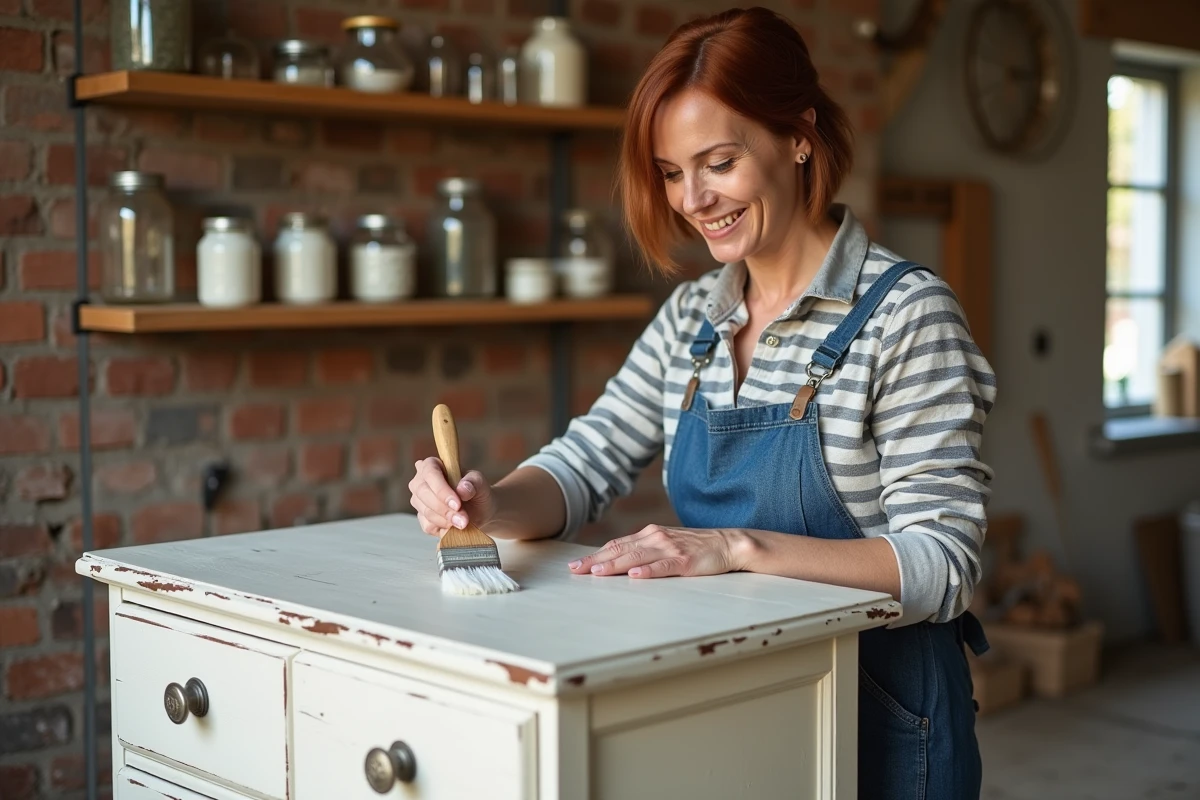
Cécile Bricole has established herself in the landscape of creative DIY in the French-speaking world with an approach that combines technical rigor and a strong aesthetic bias. Her creations cover a wide spectrum, from transforming antique furniture to partial renovations of living spaces, always with a concern for detail that goes beyond simple mainstream tutorials.
Choice of materials and finishes: what distinguishes Cécile Bricole’s creations
The quality of a DIY project relies less on the gesture than on the selection of materials. In this regard, the works signed by Cécile Bricole reveal a fine knowledge of substrates and finishing products. Furniture makeovers, for example, are not limited to a coat of paint: the choice between polyurethane varnish and hard wax depends on the use of the furniture, its wood type, and the desired effect.
We observe in her projects a marked preference for high-covering water-based paints, which allow for clean intermediate sanding without excessive emissions of volatile organic compounds. This choice also influences the visual result: a matte or satin finish, rarely glossy, consistent with current decor trends.
Browsing the works completed by Cécile Bricole, one can gauge the attention given to the preparation steps (stripping, primer application, filling) that condition the durability of each creation. Skipping the primer on a melamine piece of furniture, for example, condemns the paint to peeling within a few months.
Furniture transformation: advanced DIY techniques
Furniture makeovers form the most visible foundation of Cécile Bricole’s universe. We recommend distinguishing two categories in her creations: structural transformations and surface transformations.
Structural modifications on antique furniture
Adding splayed legs to a 1960s dresser, modifying the height of a sideboard to create a washstand, replacing a fiberboard back with a birch plywood panel: these interventions require precise tools. The router and the track saw are the two tools that separate decorative DIY from true transformation work.
Cécile Bricole’s creations demonstrate mastery of dowel assembly and invisible fastening, two techniques that preserve the aesthetics of the finished piece while ensuring its sturdiness.
Surface finishes and patinas
Old-fashioned patina, often overused in quick tutorials, requires a rigorous protocol:
- Application of a first coat of light paint, complete drying, then targeted sanding on edges and naturally worn areas to simulate aging
- Application of tinted wax or colored glaze in recesses and moldings, wiped before drying to retain only the shadows
- Final protection with a clear matte varnish or microcrystalline wax, depending on whether the furniture will be in a humid or dry area
Each step influences the final result. An insufficient drying time between coats produces unintended marbling that only a complete stripping can correct.
Renovation of small surfaces: walls, floors, and backsplashes
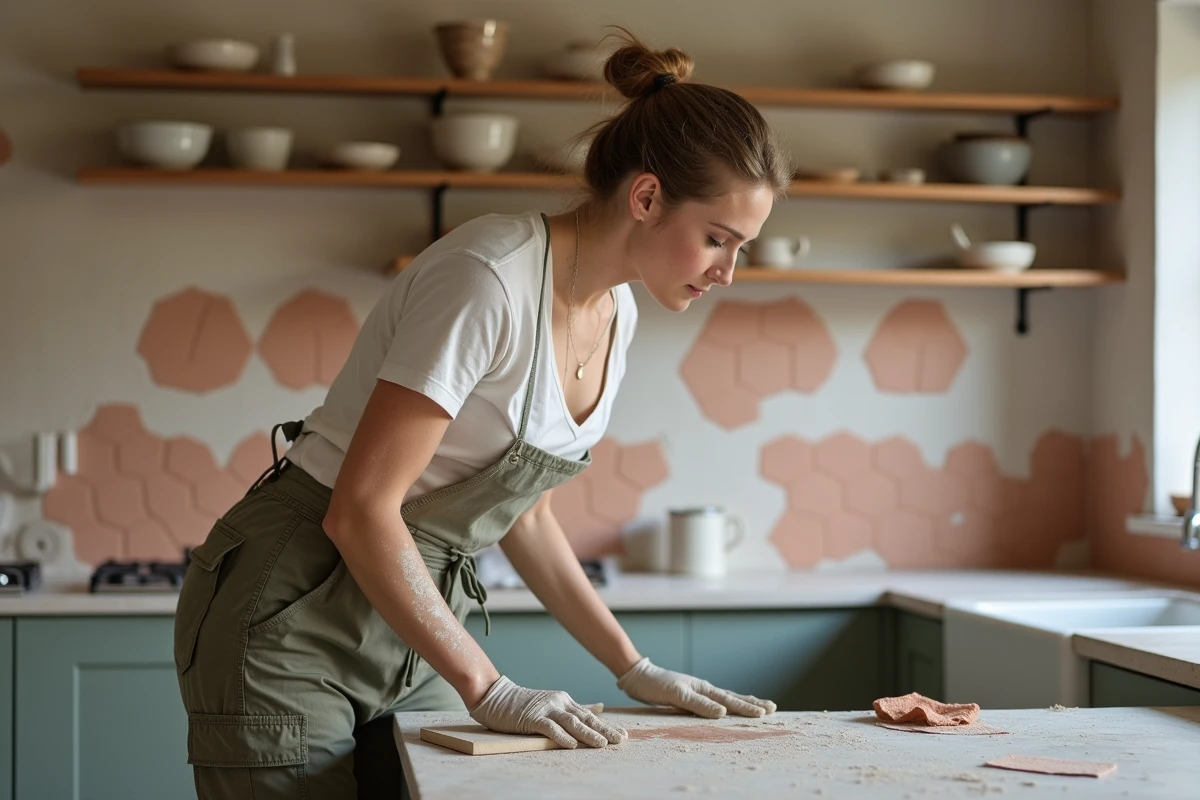
Partial renovation projects occupy an increasingly prominent place in Cécile Bricole’s work. Repainting a wall, laying adhesive tiles on a kitchen backsplash, or restoring bathroom joints: these short projects produce a disproportionate visual impact relative to the time investment.
Regarding backsplash installation, we note an approach that favors tiles set with mortar rather than self-adhesive solutions. The time cost is real, but the longevity of a tile adhered with mortar remains incomparable compared to the frequent peeling of adhesives subjected to heat and grease splashes.
For bathroom joints, the technique involves completely removing the old joint with a cutter and spatula before reapplication. Applying silicone over an aged joint only masks the problem for a few weeks.

Creative DIY and seasonal projects by Cécile Bricole
Beyond renovation and furniture transformation, part of the creations falls under seasonal decorative DIY: personalized photo frames, reclaimed wood wall shelves, creative concrete decor items. These projects, often documented in step-by-step videos, allow for transferable techniques.
The work with creative concrete, for example, requires mastering the water/cement ratio to achieve a pourable consistency without excessive porosity after drying. An overly liquid mix weakens the piece and multiplies surface air bubbles.
Reclaimed wood shelves raise the question of prior treatment: untreated pallet wood may contain chemical residues or wood-boring insects. Mechanical brushing followed by an insecticide-fungicide treatment is the minimum before any indoor use.
Tools and workshop organization to replicate these works
Reproducing the level of finish visible in Cécile Bricole’s creations requires a properly equipped workshop. We recommend prioritizing investments:
- High priority: a quality random orbital sander (surface finish directly depends on it), a set of trim brushes for corners and moldings, a low-pressure paint sprayer for large flat surfaces
- Medium priority: router with a parallel guide, sufficient clamps (we rarely use fewer than six per project), carpenter’s square
- Low but useful priority: painting station with extraction, folding workbench for outdoor work, vertical wall storage to optimize space
The organization of the workspace affects quality as much as the tools themselves. A cluttered workshop encourages cutting corners on preparation and drying stages.
Cécile Bricole’s creations remind us that home DIY achieves a professional result when each step receives the time and materials it deserves. The most costly shortcut is always the one that forces you to start over.