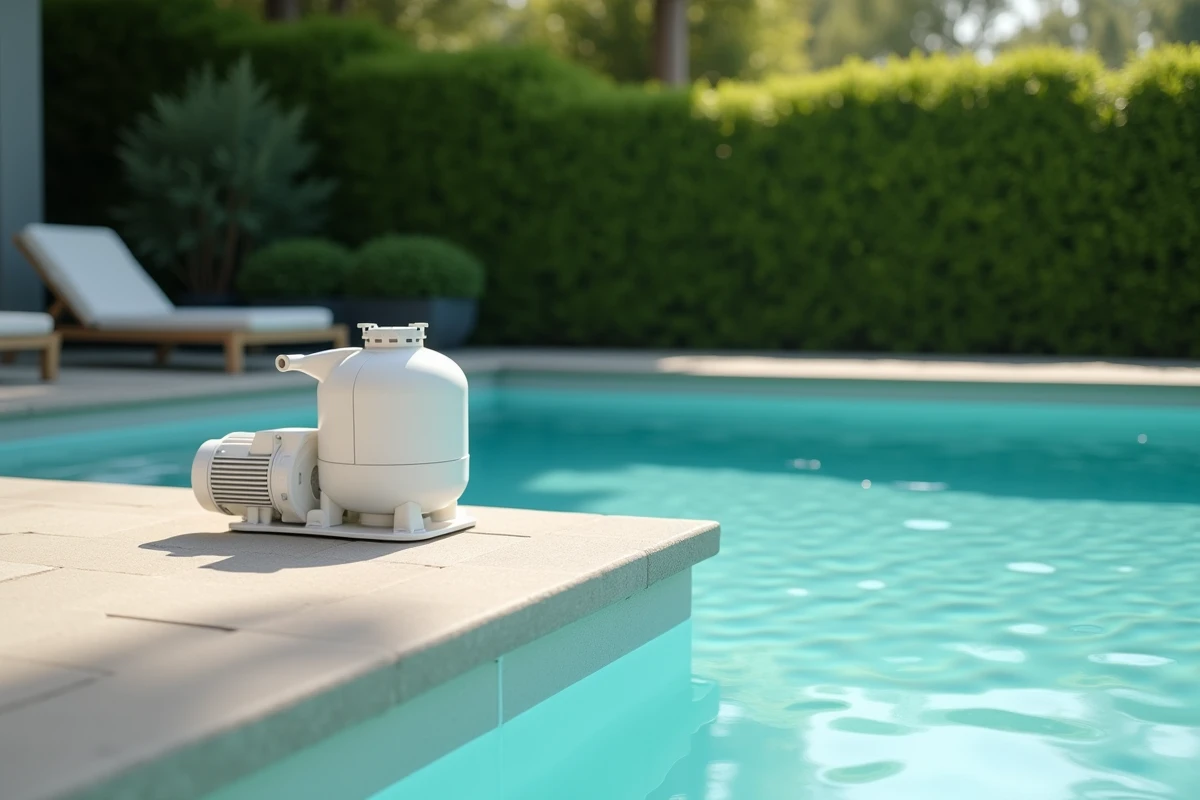
Your saltwater pool produces its own chlorine thanks to the electrolyzer, but this chlorine is useless if the water does not circulate long enough through the filter. The daily filtration duration directly affects the clarity of the pool. The catch is that most advice focuses on a single variable (temperature) while three parameters come into play.
Chlorine production by electrolysis: the parameter that guides forget
A saltwater pool remains a chlorinated pool. The electrolyzer converts dissolved salt into active chlorine, but this production only occurs when the pump is running. When filtration stops, the electrolysis cell stops as well.
Have you ever noticed slightly cloudy water in the morning after a night without filtration? This is because the pool has not received any chlorine for several hours. Organic impurities (sweat, sunscreen, plant debris) have not been oxidized.
Filtering too little also means producing too little chlorine. This link between filtration duration and disinfectant production is specific to saltwater pools. In a pool treated with chlorine tablets, the product disperses even when the pump is off. With an electrolyzer, it does not. Therefore, it is necessary to determine the optimal filtration time for the pool pump considering this specific constraint.
In practice, if your electrolyzer is set to half power and you filter too few hours, the amount of chlorine generated will be insufficient, even with a high production setting. The filtration duration drives disinfection as much as the cell setting.

Water temperature, pool volume, and attendance: three criteria to cross
The most common rule is to divide the water temperature by two to obtain the daily filtration duration. This simple formula provides a starting point, but it is not sufficient for a saltwater pool.
Water temperature and bacterial proliferation
The warmer the water, the faster microorganisms develop. Lukewarm water in spring requires less filtration than hot water in the middle of summer. Recent feedback on pool forums confirms a clear point: when the water reaches or exceeds 30 °C, filtration runs continuously, day and night.
Below this temperature, the duration varies gradually. Breaking it into short cycles (for example, two hours on, one hour off) allows for better distribution of chlorine production throughout the day rather than concentrating filtration into a single time block.
Pool volume and pump flow rate
Temperature alone does not tell the whole story. A small pool of a few cubic meters with a powerful pump circulates its entire volume quickly. A large pool with an undersized pump takes much longer to recycle all the water.
The goal is that the entire volume of water passes through the filter at least once a day. If your pump takes a long time to complete this cycle, you need to extend the filtration time, regardless of the temperature.
Attendance and environment
Every swimmer brings organic matter into the water. After an afternoon with several people in the pool, the pollution load increases. A pool surrounded by trees also receives more debris. These two factors justify adding filtration time to the basic calculation.
- After a day of intensive swimming, extend filtration by one to two hours beyond the usual duration to compensate for the organic load
- A pool exposed to wind or close to dense vegetation requires longer filtration than a sheltered and open pool
- In case of heavy rain, restart an additional filtration cycle to homogenize the treatment after the influx of untreated water
Scheduling filtration for a saltwater pool: time slots and cycles
Filtering at the right time is just as important as filtering long enough. The photosynthesis of algae accelerates under the sun’s effect. Concentrating filtration during sunny hours allows the chlorine produced by the electrolyzer to act precisely when biological pressure is highest.
Programming the pump to run mostly between late morning and early evening yields better results than an equivalent nighttime filtration. At night, the temperature drops, algae slow down: the need for chlorine naturally decreases.
Breaking into cycles rather than one block
Rather than running the pump for eight hours straight and then turning it off for sixteen hours, breaking the filtration into several time slots has a concrete advantage. The water receives chlorine more regularly, and the filter captures impurities before they accumulate.
An experienced user mentions two-hour cycles spread throughout the day, adjusted according to the measured temperature. This approach avoids long periods without treatment and reduces electricity consumption during peak hours.
Common mistakes in filtering a saltwater pool
The first mistake is applying the temperature divided by two rule without checking the actual flow rate of the pump. A clogged filter reduces the flow rate, which extends the time needed to circulate the entire volume. Regularly cleaning the filter maintains filtration efficiency.
The second mistake is believing that the electrolyzer compensates for too short a filtration time. Increasing chlorine production at the cell does nothing if the water stagnates in the pool. Chlorine must be distributed through circulation, not produced in excess in a pipe.
- Check the pump flow rate at least once per season, especially after cleaning or replacing the filter media
- Do not stop filtration at night during periods of high heat, as the water temperature remains high and bacteria continue to multiply
- Monitor the salt level and the condition of the electrolysis cell: a scaled cell produces less chlorine, which skews the entire filtration calculation
The quality of water in a saltwater pool relies on the balance between three elements: filtration duration, chlorine production by the electrolyzer, and maintenance of the filtration system. Adjusting these three parameters together, not separately, makes the difference between clear water and a pool that turns green at the first heat wave.